How They Are Enforced
Technical requirements are enforced by a person reading them.
The platform stores the text, publishes it, and hands it to demand partners. It does not parse it, and it does not compare a creative against it. Whether a creative meets the requirements is decided by whoever reviews the creative.
This page is for anyone designing the workflow around that review — the manager who plans it and the moderator who works it — and for integrators deciding what to rely on.
What the text is
Both surfaces hold formatted prose written by a person for a person. The operator can say anything, in any detail and any format, for example "Video must be H.264, no audio, under ten seconds". Attached PDF documents are published as they are.
What the platform does check when a creative arrives
A creative submitted by a demand partner passes through checks that decide whether the file is usable at all: whether it can be fetched, whether it really is the type it claims to be, whether it arrived intact and unaltered, and whether interactive creatives are allowed here. None of those checks reads a technical requirements text.
They belong to the review flow, and Creative approval covers them.
The one automatic check
There is a single place where the platform compares a creative against the inventory it is meant for, and it is not connected to this section’s text.
When a demand partner submits an automated guaranteed advertisement, the platform collects the distinct aspect ratios of the faces the advertisement is bound to, and requires the creative to carry a media variant for each one. If any ratio has no matching variant, the advertisement is refused and the missing ratios are named in the response.
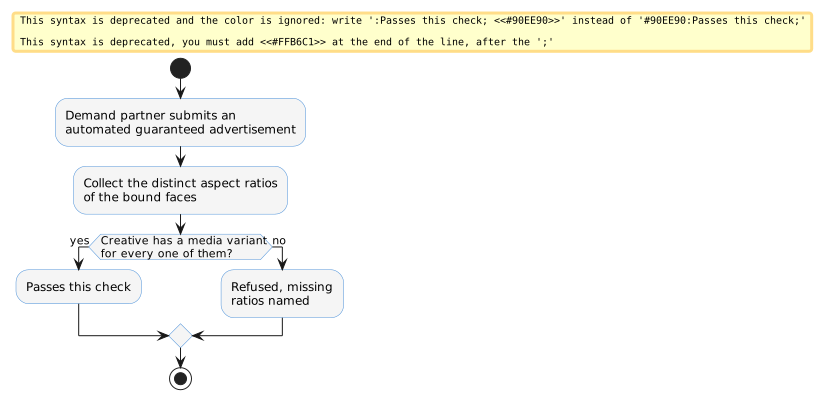
The check reads the aspect ratio recorded on the face and never loads the requirements text. It runs when an automated guaranteed advertisement is submitted, and it covers aspect ratios only.
See Automated guaranteed campaigns for the path this check sits on.
Changing requirements
Saving new text, or clearing it, edits a published document. A save replaces the note, so the previous wording is gone from the product. Approved creatives stay approved and keep running, and a review that is waiting is unaffected by an edit made while it waits. A partner sees the new text the next time it asks for it and receives no notice that it changed.
So a real change of requirements is an operational task, not a save. Tell the buyers who need to know, agree a date, and treat the campaigns already in flight as running under the old terms — because as far as the platform is concerned, they are.
Planning a workflow around this
Write for the reader you actually have: a trafficker on the buy side who will read the text once, and a reviewer on your side who will apply it by eye. Keep it short, unambiguous, and in the terms a trafficker uses.
Keep the values that can be checked where they can be checked. Pixel dimensions, aspect ratio and the minimum and maximum play duration are attributes of the face; they travel to partners in structured form with the inventory feed and, for aspect ratio on the automated guaranteed path, they are the one thing the platform acts on. Text that contradicts the face record is text that loses.
Decide in advance what a reviewer should reject for, and put that in the review instructions. The rejection reason a reviewer writes is where a technical objection to a specific creative is recorded, and it is what the demand partner is told.
Related pages
-
Publishing requirements — writing and publishing the text
-
Creative approval — the review flow that carries the human judgment
-
Inventory — the face attributes the aspect-ratio check reads