What gets billed
CityScreen Context sells airtime through four sales models, and it does not account for all four in the same place.
Two of them — auction and programmatic guaranteed campaigns — produce financial transactions. Automated guaranteed campaigns agree a price for the campaign as a whole and keep it with the campaign. Private deals are settled between the partner and the operator, with the platform holding no money position at all.
This page says which is which, and where to look for each. It is written for anyone who has to reconcile what the platform shows against what was invoiced: organization employees in the owner, admin or manager roles.
The question this page answers
The list of financial transactions is not a list of everything sold.
An operator who looks for the revenue of an automated guaranteed campaign in the transaction list will not find it there. That revenue was agreed as a campaign price before the campaign ran, so it lives with the campaign, and its settlement document is the automated guaranteed report. The same is true, for a different reason, of private deals.
The two models
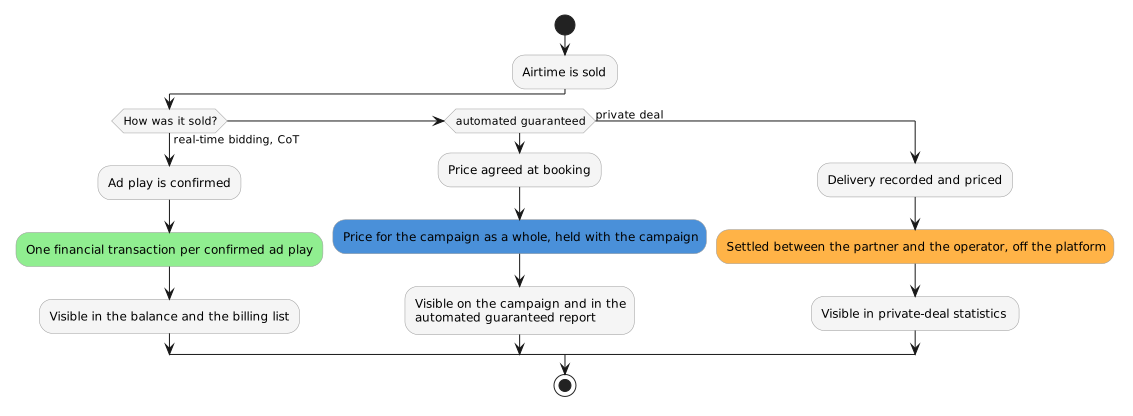
Model one — a financial transaction per confirmed ad play
Used by real-time bidding, and by the CoT integration, which is not a sales model of its own but is accounted for the same way.
Nothing is recorded when a bid is won. The record is written when the content management system confirms that the advertisement actually played and the ad request is marked successful. An ad play that goes unconfirmed, or is confirmed too late to be matched, produces no financial transaction — see Late and lost plays for the window.
Model two — a price for the campaign as a whole
Used by automated guaranteed campaigns.
The price is settled when the campaign is booked. Each face on the campaign carries the agreed price of one ad play on it, the number of ad plays planned, and, where one was negotiated, a total for that face. Those figures are part of the campaign, and they are what the campaign is worth whatever happens afterwards.
Delivery is still recorded play by play, and each recorded ad play carries its own value and its own commission worked back out of the campaign’s agreed price. Those per-play figures exist so the automated guaranteed report can be broken down by face, by advertisement and by period. They are not financial transactions and do not appear in a balance.
Where each one’s money lives
The four sales models, and the CoT integration alongside them:
| Sold as | Where the money is recorded | Where you see it |
|---|---|---|
Real-time bidding |
One financial transaction per confirmed ad play, for the full winning bid, plus one for the platform’s commission on it. |
The Balance tab, and the billing list, one row per ad request. |
Programmatic guaranteed campaign |
Financial transactions, but written once when the campaign is activated — the agreed budget is split into a monthly schedule and the whole schedule is recorded at that moment, together with the platform’s commission per face. |
The Balance tab, and the programmatic guaranteed variants of the monthly settlement report. |
Automated guaranteed campaign |
Not as financial transactions. The agreed price per ad play, the planned number of ad plays and any negotiated total are held on the campaign’s own booking lines. |
The campaign itself, and the automated guaranteed settlement report. |
CoT |
One financial transaction per confirmed ad play, at the flat price set on the organization tariff. |
The Balance tab, under the amount owed to the platform. |
Private deal |
No financial transaction and no balance movement. Each confirmed ad play is recorded with the amount the platform charges for it, so that it can be reported. |
Private-deal statistics, and the private-deal lines appended to the monthly settlement report. |
Real-time bidding, in detail
When an ad play is confirmed, four records are written as two pairs.
-
The winning demand partner now owes the organization the full bid, and the organization’s own balance rises by the same amount.
-
The organization now owes the platform the commission on that bid, and the platform’s balance rises by the same amount.
The organization’s share is the difference: it holds the gross bid and owes the commission out of it. See Fees and commission for how the commission is worked out.
Where an organization’s inventory is sold through the platform operator’s own demand relationships rather than the organization’s, the same event is recorded the other way round: the buyer owes the platform, and the platform then owes the organization the bid less commission. The commission is kept back before the organization is credited instead of being charged to it afterwards.
Programmatic guaranteed campaigns
A programmatic guaranteed campaign reserves a budget and a number of hourly ad plays ahead of time, then delivers through the ordinary auction path.
Its money is recorded once, at activation. The campaign’s budget is spread across the months it covers, and one payment record per month is written, along with the platform’s commission and the operator’s share for each face involved. That happens whether or not the campaign goes on to deliver its whole reservation.
Delivered ad plays from a programmatic guaranteed campaign are still confirmed and reported like any other, and they appear in the programmatic guaranteed variants of the monthly settlement report. They do not produce a second, per-play financial transaction.
See Programmatic guaranteed for the commercial model.
CoT
Deliveries arriving through the CoT integration are not priced from a bid. They are charged at a single flat price per ad play, set per organization on the organization tariff, and the record written is one-sided in the sense that matters: it says the organization owes the platform that amount for that ad play.
If that flat price is left at zero, deliveries are still recorded and reported, and no financial transaction is written for them.
Automated guaranteed campaigns
An automated guaranteed campaign is priced when it is booked.
The price of one ad play on each face comes from the automated guaranteed price list that covers it, with the platform’s automated guaranteed commission added on top, and it is frozen onto the campaign’s booking line for that face. Alongside it the booking line carries the number of ad plays planned and, where the parties agreed a lump sum rather than a per-play rate, the negotiated total.
When the campaign is amended and re-agreed, those figures are recomputed from the price list’s price and the commission in force at that moment, and the campaign carries the new ones.
Settlement is the automated guaranteed report. It is built from the recorded ad plays and totals the value and the commission over the period, per face, per advertisement and per campaign, against the planned figures. It is produced on request — see The billing period.
See Automated guaranteed for booking and Automated guaranteed prices for how the price list sets that price.
Private deals
A private deal is fulfilled by the partner’s own system, which chooses what plays on the face and sets the price it pays for it.
That price is agreed and settled between the partner and the operator, and the platform is not part of that exchange. On the settlement report a private-deal line carries a count of ad plays and the platform’s own charge.
What CityScreen Context does record is each confirmed ad play and what it charges for it, taken from the private-deal commission configured for that organization, partner and face. No financial transaction is written and no balance moves.
Private-deal lines are appended to the direct variants of the monthly settlement report, so a period’s private-deal delivery does appear in the same document as the rest.
Related pages
-
Billing — accounts, balances and recording a payment
-
Fees and commission — how the platform’s cut is set and applied
-
Reporting — one row is one confirmed ad play