Late and lost plays
An ad request that is not confirmed within two hours of being answered is written off. After that, the platform accepts no confirmation for it from any source.
This page is for the organization employees who reconcile revenue. The deadline is the same for every organization.
Which sales models this applies to
The deadline governs the ad request, so it applies to everything that goes through one: ordinary real-time bidding, programmatic guaranteed campaigns, and inventory supplied to an exchange.
COT, automated guaranteed and private-deal plays are not governed by it. COT closes out its own unanswered requests on a window of its own, and a COT play is still recorded and priced whenever it is found. Automated guaranteed and private-deal plays are recorded whenever they are found.
The window
The window is two hours from the moment the ad request is answered. An ad request still unconfirmed when the window ends is marked failed.
What "failed" closes off
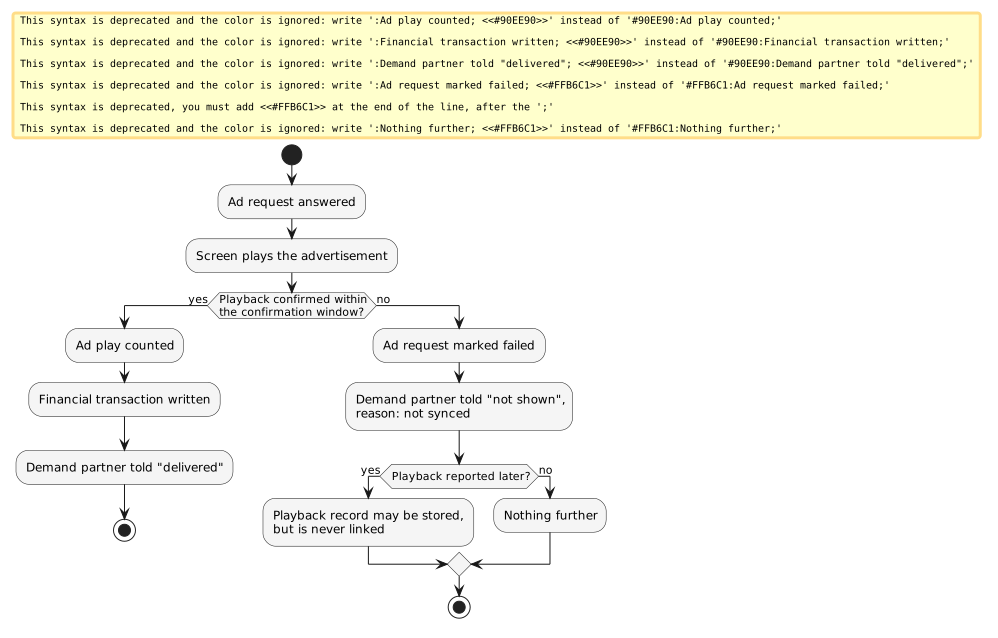
Once an ad request is failed, nothing can confirm it afterwards. A playback reported later produces no financial transaction, does not appear on the Statistics screen, is absent from the direct, indirect and programmatic guaranteed reports, and is never reported to the demand partner as delivered. The play happened, and the revenue it would have brought is not counted.
The demand partner is told
Marking an ad request failed sends the demand partner an unshown notice for that opportunity, carrying a reason indicating the playback was never synchronized, together with the price that would have been charged.
This matters for reconciliation. The platform notifies the outcome of each opportunity to the demand partner, delivered or not shown, and retries the notice, up to a retry limit, until the partner acknowledges it. A written-off play is therefore reported to the buyer as not shown.
What an operator should do
Nothing recovers a written-off play, and running the synchronization again does not bring it back. The remedy is to prevent further loss.
Look for one of these.
-
The content management system was unreachable for longer than the window. Two hours of downtime writes off every opportunity issued during it, even though the screens kept playing from their local schedules.
-
Clock skew. A content management system whose clock differs noticeably from the platform’s reports plays outside the periods the platform asks about.
-
Screens that report in batches. A player that buffers playback records while offline and uploads them at the end of the day delivers them long after the window has closed. So does a content management system that aggregates before exposing its playout data.
-
A face reporting nothing at all. If a face never confirms a play, all its ad requests are written off. This points at the integration.
A rise in unshown notices to demand partners with a not-synchronized reason is the earliest signal that one of these is happening.