Sales models
The seller and the buyer of DOOH airtime are not counting the same thing: an operator sells ad plays, while an advertiser wants to buy an audience. One play of an advertisement reaches anywhere from nobody to a crowd. Programmatic selling is how the two sides meet: the ad play stays the unit that is delivered and billed, and what a play costs can follow the audience it is expected to reach.
CityScreen Context sells airtime four ways. They differ in the kind of slot they play in, who chooses the creative, where the price comes from, what is reserved in advance, and where the money shows up afterwards.
This page is for anyone with a commercial stake: an operator deciding what to offer, a buyer deciding what they are buying, and an employee trying to work out why a figure is not where they expected it.
Two kinds of slot
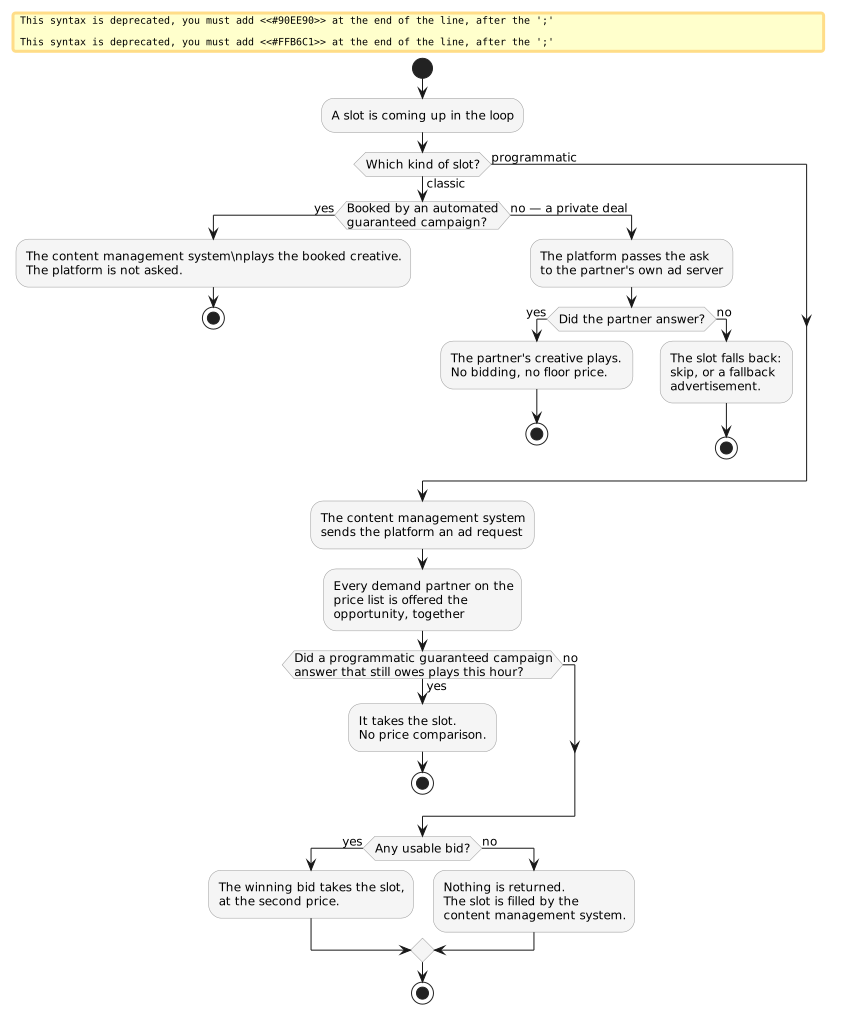
The player’s loop is a sequence of slots, and a slot is one of two kinds.
A classic slot is sold before it plays. The content management system controls the playout: it either already knows the creative — an automated guaranteed booking — or it knows which partner to ask for one, which is a private deal. It does not need an internet connection at the moment of play; a private-deal slot that gets no answer falls back to a configured action — skip, or a fallback advertisement.
A programmatic slot belongs to nobody until seconds before it plays. The content management system sends CityScreen Context an ad request, and CityScreen Context decides what the slot carries: a programmatic guaranteed campaign still owed plays takes it first, otherwise the auction does. An internet connection is mandatory.
Real-time bidding and programmatic guaranteed play in programmatic slots; automated guaranteed and private deals play in classic slots. One classic spot cannot be held by an automated guaranteed campaign and a private deal at once.
The four models side by side
| Auction | Programmatic guaranteed | Automated guaranteed | Private deal | |
|---|---|---|---|---|
The slot it plays in |
A programmatic slot |
A programmatic slot |
A classic slot |
A classic slot |
Who chooses the creative |
CityScreen Context, per opportunity |
Shared — the demand partner decides what to offer, or offers nothing; CityScreen Context decides which owed campaign takes the slot |
The content management system, from a booked schedule |
The partner’s own system |
Does it go through the auction |
Yes |
Yes, drawing on a reservation |
No |
No |
Where the price comes from |
The winning bid, cleared |
A price list frozen when the campaign was reserved |
A price grid on the automated guaranteed price list, agreed when the campaign was reserved |
Agreed outside the platform; the platform records only what the partner reports, or nothing |
Is the price agreed before delivery |
No |
Yes |
Yes |
Yes — outside the platform. The platform itself sees a price only with the delivery, or not at all |
What is reserved in advance |
Nothing |
A budget, and an allowance of plays per hour on each named face |
Volume — a frequency, over a period, on named faces |
A classic slot — a fixed place in the loop; the deal’s volume and price live outside the platform |
What the reservation is checked against |
— |
What other pre-negotiated buys have already claimed on the same face, hour and creative length |
The face’s measured capacity, over the whole campaign period |
A booked classic spot is not handed out twice: an automated guaranteed campaign and a private deal cannot hold the same one |
Who starts it |
A demand partner submits a creative |
A demand partner proposes terms |
A demand partner proposes; the operator reviews and reserves |
A partner integration is switched on |
Where the money is recorded |
A financial transaction per confirmed ad play |
Financial transactions for the whole budget, written once at activation |
A price for the campaign as a whole, in the campaign’s own data |
Settled outside the platform |
Auction
The default model, and the one everything else is measured against.
A demand partner submits a creative, it is reviewed, and the campaign then simply exists in a state the auction consults. Nothing is booked, nothing is promised, and no money changes hands until a play is confirmed.
For each opportunity, the platform offers the slot to the demand partners the covering price list names, together, and compares what comes back. The auction is second price, so the winner usually pays less than it bid.
An ordinary auction campaign runs whenever it wins. It stops running when the demand partner stops bidding, when the operator declines it, or when it is paused after a long spell without being served.
-
RTB Auction — the auction, end to end.
-
How the winner is chosen — the second-price rule and the cap inside it.
-
Campaigns — the campaign object itself.
Programmatic guaranteed
A pre-negotiated buy between one demand partner and one organization, agreed and paid for before anything runs, and then delivered through the ordinary auction path — the same programmatic slots.
The partner proposes the faces, the schedule, the creative duration, how many plays per hour it wants and a budget. The platform prices that against its own price list. If the proposed budget matches, the campaign is reserved straight away; if it does not, it goes to review and someone has to accept it.
Reserving does two things. It sets aside a money balance, and it computes a per-face, per-day allowance of plays broken down by hour, worked out so that two such campaigns cannot reserve the same airtime on the same face twice. A reservation that is never activated expires, and the campaign is cancelled.
At auction time the campaign does not bid, and the decision is shared. The demand partner still answers each ad request, choosing which creative to put forward — or putting forward none — while CityScreen Context holds the campaign to its reserved allowance. While the campaign still owes plays for the current hour, its answer takes the slot ahead of every bid, with no price comparison at all. When several are in that position, CityScreen Context picks the one that has gone longest without being shown relative to its own agreed interval, which is the one furthest behind its own quota.
Both halves of the commercial promise are therefore settled before delivery starts: the price, frozen on the price list at reservation, and the volume, held against every other pre-negotiated buy on the same face and hour. The reservation settles price and volume; the plays actually delivered depend on the face running.
Programmatic guaranteed covers the negotiation, the states and the reservation in detail.
Automated guaranteed
A classic direct buy with the trafficking automated: booked volume at an agreed price, played by the content management system in classic slots of its own loop, with proof of play travelling back through the platform instead of by spreadsheet.
A demand partner proposes a campaign — faces, a period, a frequency, a creative duration. An employee of the operator reviews it, sets the per-face frequency, duration, price and time windows, and moves it to reserved.
Moving it to reserved is where the volume is committed. At that moment the platform recomputes capacity for every targeted face over the whole campaign period and refuses the reservation if the requested frequency would push total booked demand past the ceiling the organization’s automated guaranteed price list allows. That ceiling starts at the measured capacity and cannot be set below it; an operator who wants to sell beyond physical capacity has to raise it deliberately.
Once the campaign and at least one of its advertisements are confirmed, the whole thing is pushed into the content management system, which schedules it in its own playout. It never enters the auction and never competes with a bid.
Pricing is frequency-based, taken from a price grid on the automated guaranteed price list, and the campaign carries one price for itself as a whole, and no financial transaction is produced for each play. That is the answer to the question the billing section gets asked most often — see What gets billed.
The capacity check settles that the booked volume fits.
Delivery of this kind is available to organizations whose screens are run by the platform’s own content management system.
-
Automated guaranteed — the product.
-
Booking and capacity — the reservation gate.
-
Under-delivery — delivery against the booking.
Private deal
A classic slot sold ahead of time to a named partner whose integration supports it — a reserved, non-auction path.
The slot itself is fixed in the loop, like an automated guaranteed booking, and the deal’s volume and price were agreed outside the platform. The partner’s own ad server decides what plays in it. The platform passes the request through, records what came back, and learns afterwards whether it played. The partner’s ad server gives the one answer, so there is no bidding and no floor price.
The price is not set here either — it was agreed outside the platform. One of the supported partners reports what it paid; the other transmits no price to the platform at all. What the platform computes is its own commission on top, and what it stores against the delivery is that commission — not the media price.
Settlement happens outside the platform. Nothing about a private deal appears in the organization’s financial transactions.
| The deal of CityScreen Deals is a sales contract and a different thing from a private deal here. |
Private deals covers the model, and Supported partners says which integrations support it.