Programmatic guaranteed
A programmatic guaranteed campaign is a buy agreed in advance and paid for in advance. A demand partner names the faces, the period, the daily hours, the creative length and how many plays per hour it wants. The platform prices that, holds the money and the airtime, and then delivers it down the same path as everything else, taking the reserved hours ahead of every bid.
It is the middle ground between the open auction, where nothing is agreed ahead of time, and an automated guaranteed campaign, where an employee books a fixed number of plays and the content management system delivers them outside the auction entirely.
This page is for the owner, admin, manager and moderator employees who negotiate these buys. Availability of this deal type is licensed per deployment.
See PG Price Lists for how these campaigns are priced.
What the reservation covers
Reserving does three things.
-
It fixes the price. The per-play prices are taken from the covering price list at the moment of reservation and frozen on the campaign. A later change to the price list does not reach a campaign already reserved.
-
It holds the volume. For each face, each date and each hour in the campaign’s own schedule, the platform records how many plays this campaign has claimed, and creates a balance at the agreed budget that only this campaign draws on. Those claims are computed net of everything every other active and reserved campaign of this type has already claimed on the same face, date and creative length, so two of them never claim the same hour twice.
-
It buys precedence. When one of the reserved hours comes up on one of the reserved faces, this campaign takes the slot ahead of anyone bidding for it, at the price agreed in advance — see Programmatic guaranteed campaigns come first.
Price and volume are therefore both settled before a single play happens, which separates this deal type from the auction.
Delivery goes down the ad request path. The face still has to send an ad request in that hour, the demand partner still has to answer, and the answer still has to pass the checks every answer passes. The number of reserved hours that come up depends on the screens running: a screen that is dark, offline, deactivated or asked for fewer slots than expected delivers fewer plays.
The commercial statement to make to a buyer is this:
Your price is fixed, and your share of each hour is held against every other pre-negotiated buy on that face. When one of your hours comes up you go first, ahead of anybody bidding. How many of those hours come up depends on the screens running over your period.
The negotiation
Everything up to activation is a conversation between the demand partner and the employees who price the deal.
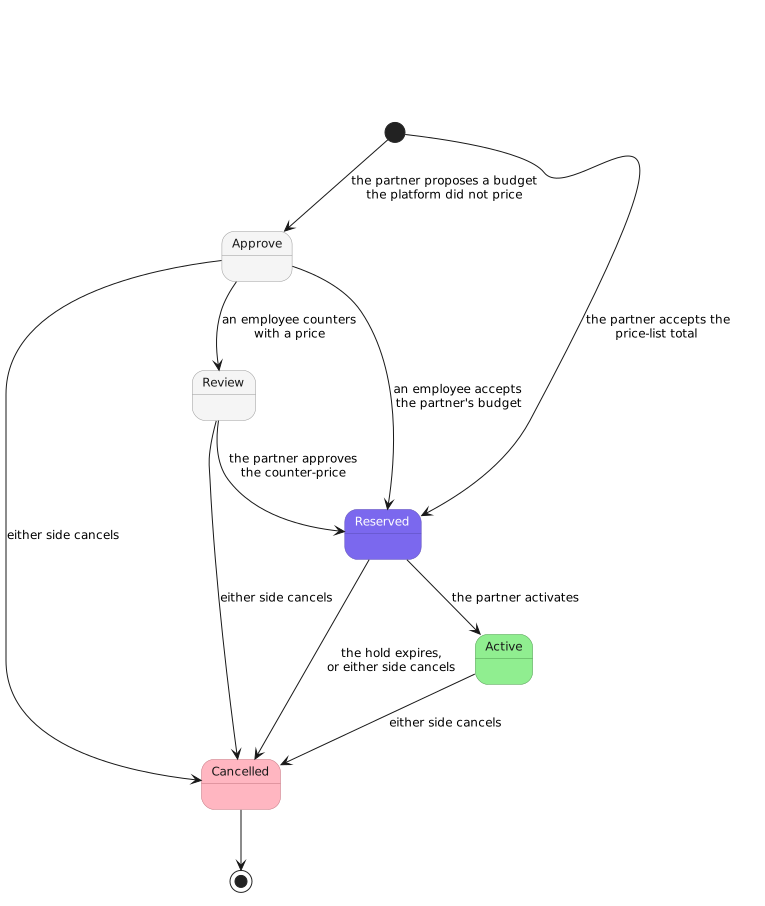
| State | What it means |
|---|---|
Approve |
The partner proposed a budget that differs from the platform’s price-list total for what it asked for. Someone has to decide. |
Review |
An employee has countered with a different figure and the partner has not answered yet. |
Reserved |
The budget and the slots are held, with an expiry. Nothing is delivering, and nothing has been billed yet — the transactions are written at activation. |
Active |
Delivering. |
Cancelled |
Finished, by expiry or by either side. The reserved slots are released; transactions already written at activation stay. |
Error |
The request could not be turned into a campaign — no capacity, or no price list covering the period. Nothing is held, and the reason waits on the campaign for the partner to read. |
Where the two entry points come from
When a partner submits a campaign, the platform prices exactly what was asked for against the covering price list and compares that total with the budget the partner offered.
If the partner offered nothing, or offered exactly the price-list total, the campaign goes straight to reserved and the holds are taken immediately. If the partner offered a different figure, the campaign lands in approve and waits for a human.
What an employee can do
Campaigns are listed by state, and the tab labeled new shows campaigns in approve and in review together, because those are the two states that need an answer from your side.
Opening a campaign shows the period, the creative length, the budget, the plays per hour, the average unit price, the schedule and — where the partner asked for different terms per face — a per-face table of plays, schedule, price dates and totals.
Owner, admin, manager and moderator can act on a campaign belonging to their own organization. A viewer sees the same pages and no buttons.
Three actions are offered, and only on the states that accept them.
- Review
-
Counter with a different budget, and optionally a message. The campaign moves to review, the figure is recorded as the new campaign budget, and the face-level price lists are rescaled to match it. Available from approve and from review.
- Reserve
-
Accept the campaign at its current budget and take the holds. The budget submitted with this action has to equal the campaign’s current budget exactly. Available from approve only, because a campaign in review is waiting on the partner and its counter-offer is settled by the partner.
- Cancel
-
End it. Available from any state.
Activation belongs to the demand partner.
|
The demand partner learns the new state of a campaign by reading it back: the answer carries the current state and the reserved-until time. A counter-offer you send is therefore seen by the partner when it next reads the campaign, so send the message that goes with it outside the platform if you want it answered. A reservation you take on the partner’s behalf can expire before the partner reads the campaign, because the hold is limited in time. |
What the demand partner does
The partner checks what is free before committing to anything, then submits the campaign, naming the faces, the period, the daily hours, the creative length and how many plays per hour it wants — either the same terms on every face, or different terms face by face. Submitting is what puts the campaign in front of the operator’s employees; the partner is told the submission was accepted straight away, and the pricing and capacity work happens afterward. The partner learns what happened to the campaign by reading it back — see the note above. Answering a counter-offer takes effect while the campaign is in review, and only if the budget it carries matches the countered figure exactly; then the campaign becomes reserved. Activating turns a reserved campaign into a delivering one, and clears the expiry.
A programmatic guaranteed campaign wraps campaigns that moderation has already cleared, using the same creative identifiers the partner quotes when it bids, and every one of them has to already exist here as an approved, non-rejected campaign.
The requested plays-per-hour figure applies to each hour of the campaign. A campaign can be made strict about frequency: an hour that cannot supply the requested number of plays in full then contributes nothing, and a face that cannot supply the full frequency in every one of its scheduled hours is reported back as unreservable, and nothing is partly reserved. Without strict frequency, the campaign takes whatever a given hour has left. Strict frequency suits a buy that is only worth having at its stated frequency.
What a submission is checked against
Checking happens in two stages.
The first happens immediately, before the partner is told anything: a submission that fails it is rejected outright, with the problem identified, and nothing is created. That covers creatives that do not belong to this partner in this organization or are not in a usable state, creatives of mismatched lengths within the same campaign (a campaign of this type holds one creative length only), faces that do not exist in this organization, an end date already in the past, and a requested frequency that does not physically fit inside an hour at the requested creative length — for example, 360 ten-second plays in one hour is refused, 300 is not. It also covers resubmission: once a campaign has been reserved or gone active, its terms are fixed, and changing them means cancelling and starting again; resubmitting under the same identifier is possible while it is still in review.
The second stage happens afterward, once the submission has already been accepted, and this is where a campaign can land in error: no face had a free slot at the requested length and frequency, the campaign priced out at zero plays, or a face had no price list covering the period. The partner finds out by reading the campaign back.
The reserved hold expires
A reservation holds money and slots until its reserved-until time, which is shown on the campaign page while the campaign is reserved and cleared the moment it activates. A reserved campaign that passes that time is cancelled, releasing the money and the slots for someone else.
The hold is a place in the queue while the partner finishes its own approvals. A partner that lets it lapse starts again from checking what is free, against whatever is available by then.
How an active campaign delivers
Delivery is the ordinary auction path — the same programmatic slots real-time bidding uses — and draws down the reservation.
The decision at each opportunity is shared. The demand partner answers the ad request as usual and may put its programmatic guaranteed campaign forward, with a creative of its own choosing, or leave it out and let the opportunity pass. CityScreen Context takes an answering campaign that is active, inside its own dates, and scheduled for the current hour on this face, at the reserved unit price for that face and hour.
A play is drawn from the campaign’s reservation only while the campaign has reserved plays left. The reserved play count is the hard limit on the campaign, and the budget is drawn down alongside it. The two were computed from each other at reservation — the budget is the sum of the per-play prices for exactly those plays — so they run out together. When the reservation is used up, the campaign no longer answers and the slot goes to the ordinary auction.
What is drawn is a delivery allowance. If the campaign loses the opportunity, or the play is never confirmed, the allowance comes back. The money itself was recorded earlier, when the campaign activated: financial transactions for the whole reserved budget, written once, and a confirmed play raises no further transaction — see What gets billed. The allowance decides delivery: whether the campaign still takes precedence over bids, and when it stops.
The hourly allowance sets precedence
Within the current hour, the campaign has an allowance equal to the plays it reserved for that hour on that face.
-
While the allowance still has room, this campaign takes precedence over price comparison. No bid is weighed against it.
-
Once the allowance is used up for the hour, any ordinary bid in the same auction is compared normally and can take the slot.
-
If no ordinary bidder answered at all, the campaign can still take the slot with its hourly allowance spent.
The hourly figure therefore decides who goes first, and the reserved play count bounds the total. On a face nobody else is bidding on, the campaign runs ahead of its stated frequency and finishes its reserved plays early.
Where several programmatic guaranteed campaigns are eligible for the same slot, they are not compared on money. CityScreen Context prefers the one that is furthest overdue against its own spacing between plays — the one furthest behind its own quota — and one that has not run yet on this face counts as the most overdue. That spreads each campaign’s plays across its hour instead of firing them off back to back.
How an active campaign ends
An active campaign stops being eligible when its end date passes or when its reserved plays are used up. A campaign that has spent its plays is still listed as active. Active on this page means "not cancelled and not still being negotiated", so read the remaining plays when a buyer asks whether a campaign is still running.
Cancelling an active campaign ends delivery immediately and releases the reserved slots. The financial transactions written at activation are not reversed — see What gets billed.
What these campaigns share with ordinary ones
A programmatic guaranteed campaign is a wrapper. Underneath it sit ordinary campaigns and their advertisements — the same objects, created by the same creative approval, carrying the same photo captures.
Which means:
-
The creatives went through moderation like any others, before the programmatic guaranteed campaign was ever submitted.
-
Declining the underlying campaign takes the creative out of circulation, including out of this one.
-
Photo captures appear on the underlying campaign’s shots tab, which is separate from the programmatic guaranteed campaign’s own page.
-
The faces were fixed when the campaign was reserved, and the reservation governs which faces it answers for.