Product Overview
What is CityScreen Context
CityScreen Context is a supply-side platform (SSP) for digital out-of-home advertising. It sells the airtime on a screen operator’s screens, on that operator’s behalf, to the buyers connected to it.
It does not own screens, does not play anything on them, and does not buy advertising. It sits between the system that runs the screens and the systems that want to advertise on them, and it decides what is sold, to whom, and for how much.
This page is for everyone: an operator evaluating the platform, an employee about to use it, and an integrator about to connect a system to it. Later sections are addressed to specific roles and say so on their first screenful.
Key concepts
- Organization
-
One screen operator’s world on the installation, and the boundary of everything else on this list. Inventory, prices, campaigns, employees and money all belong to exactly one organization, and one login belongs to exactly one organization permanently. The Organization
- Screen and face
-
A screen is the physical structure at a location. A face is one sellable, independently biddable surface on it — a screen with two sides has two faces. Everything commercial happens at face level: prices, price lists, activation, availability and reporting. Screens, Faces and Displays
- Inventory
-
The collective word for an organization’s whole catalog of faces. It is never used for one of them. The catalog is pulled from the content management system. Synchronization
- Price list
-
The object that decides which demand partners may buy which faces, at what floor price, and how competing answers are compared. An organization with no price list sells nothing. RTB price lists
- Creative
-
A media file a demand partner has submitted, with the metadata that describes it. It is reviewed before it can play, and the review is what an operator’s employees spend most of their time on. Creative Approval
- Ad request
-
A content management system asking the platform what to play in a slot that is about to run. The answer — a creative identifier and a price — is decided inside a fixed time budget. RTB Auction
- Ad play
-
One confirmed playout of one creative on one face, reported back by the content management system after the fact. Ad plays are what the platform counts, prices and bills; nothing is billed on the strength of having won. Reporting
- Demand partner
-
Any buyer connected to the platform — a demand-side platform, an ad network, or another exchange. The platform-wide registry records what kind of buyer each one is, which decides what it is allowed to do. Integrations
Where the platform sits
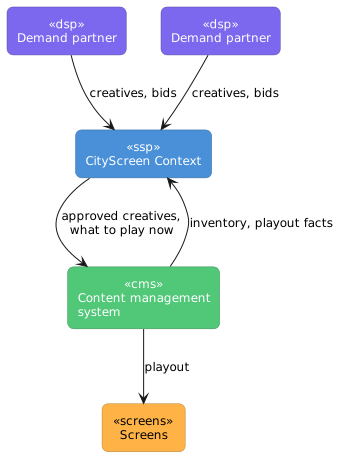
- Content management system
-
The operator’s own system, which knows the screens, schedules the playout and reports back what actually ran. CityScreen Context pulls the catalog of sellable airtime from it and returns decisions to it. Several content management systems are supported, and which one an organization uses is recorded as its server type. See Integrations.
- Demand partner
-
CityScreen Context asks its demand partners what they will pay for a given moment of airtime, and passes their approved creatives on to the content management system. See Managing demand partners.
- Screens
-
The physical screens. CityScreen Context never talks to them. Everything it knows about them comes from the content management system, and everything it decides reaches them through the content management system.
What the platform is responsible for
- Knowing what is for sale
-
The catalog of screens and faces is pulled from the content management system on a schedule and kept current. An operator does not type its inventory in. See Inventory.
- Deciding what may run
-
Creatives submitted by demand partners are reviewed before they can play, by the operator’s own employees or automatically for partners the operator trusts. See Creative approval.
- Setting the price
-
Price lists decide which partners may buy which faces, at what floor price, and how competing bids are compared. See RTB price lists.
- Choosing a winner, per opportunity
-
For each moment of airtime, the platform asks its demand partners, picks one answer and returns a creative identifier and a price. See The auction.
- Counting what ran
-
Confirmed plays are pulled back from the content management system, recorded, priced and reported. See Reporting.
Four ways airtime is sold
The platform offers four commercial models, and they behave differently enough that mixing them up produces wrong expectations about price, volume and reporting.
| Model | In one line |
|---|---|
Auction |
Demand partners bid for each moment of airtime and one bid wins. |
Programmatic guaranteed |
A buy agreed and paid for in advance that reserves a budget and a number of plays per hour on named faces, then takes those hours ahead of every bid. |
Automated guaranteed |
A direct buy with the trafficking automated — reserved volume at an agreed price, checked against capacity when it is booked, then played by the content management system without an auction. |
Private deal |
A named partner’s own system chooses what plays; the platform records the delivery and takes its commission. |
Sales models sets out what each one is.
Next
-
Sales models — the four commercial models side by side.
-
How it works — the four flows the platform runs, and how often each one runs.
-
Roles and access — who can do what.
-
Deployment model — one instance, one market, one currency.
-
Getting started — the order of operations for a new operator.