Automated guaranteed campaigns
An automated guaranteed campaign is a booked buy: an agreed number of ad plays, on named faces, over an agreed period, at an agreed price. It reserves volume ahead of time — a frequency, over a period, on named faces — and it is the only sales model in CityScreen Context where an employee of the operator decides what is sold. It plays in a classic slot: sold before it plays, with the content management system controlling playout outside the platform’s auction.
This page is for the employees who run that desk — an owner, admin, or manager, who can review and reserve, and a viewer, who can read everything and change nothing. It is also useful to an integrator building the demand-partner side, because the same objects appear on both sides of the interface.
The other pre-negotiated deal type, programmatic guaranteed, also settles price and volume before delivery, and is delivered through the auction.
Where it lives
In the client cabinet, under Guaranteed. Campaigns are listed under six tabs — approving, reserved, booked, processing, completed, rejected — and opening one gives three tabs of its own: inventory, ads, and shots, the last being the photo captures taken while the campaign ran.
Automated guaranteed selling is available where the platform’s own content management system runs the screens.
The two objects
An automated guaranteed campaign is a container. It carries the commercial terms and a list of faces, each with its own periods, frequency, creative duration, broadcast windows and price.
An advertisement sits inside the campaign and carries the creatives. It has its own period, which must fall inside the campaign’s, and it may target all the campaign’s faces or a subset of them. A campaign can hold several advertisements — a different creative for a different fortnight, or a different creative for a different face.
Creatives themselves are reviewed separately, as layouts, before they can be attached to a confirmed advertisement.
The lifecycle
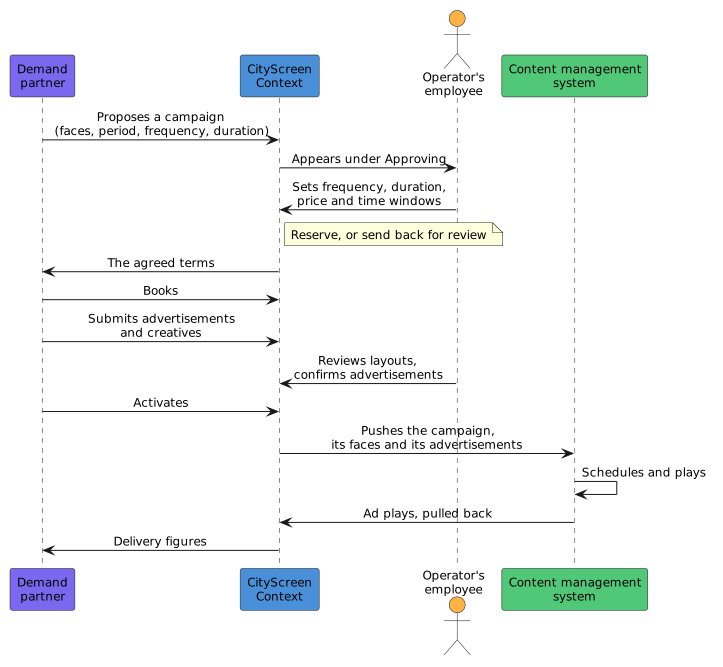
-
A demand partner proposes a campaign. Either CityScreen Context polls the partner and picks the proposal up, or the partner submits it directly. The campaign arrives in approving.
-
An employee opens it and works through the inventory tab, setting for each face the frequency, the creative duration, the broadcast windows and the periods. The platform computes the number of plays those terms produce and multiplies it by the price from the automated guaranteed price list to give a total, which the employee may discount.
-
The employee either reserves the campaign or sends it back for review. Reserving is the capacity check — see Booking and capacity. Sending it back for review returns the amended terms to the demand partner and waits.
-
The demand partner books the reserved campaign.
-
Advertisements arrive, their creatives are reviewed as layouts, and the employee confirms each advertisement.
-
The campaign is activated. It cannot be activated while none of its advertisements is confirmed; the platform refuses the request and says so.
-
On activation the whole campaign is pushed into the content management system, which schedules it — see Delivery.
-
Ad plays are pulled back from the content management system and stored against the campaign.
-
A running campaign moves to completed once its period has passed.
Campaign states gives the full transition tables for both objects, including who may make each move.
Why a person reserves it
The platform sees capacity: it asks the content management system how saturated each face is over the requested window, subtracts what other automated guaranteed campaigns have already booked, and refuses a reservation that does not fit.
The employee is in the loop because the terms are the operator’s to set. A proposal arrives with a requested frequency and a cost; what gets reserved is the frequency, duration, broadcast windows and price the operator sets, priced from the operator’s own AG price list, with any discount the operator chooses to give. The partner then books those terms or walks away.
Where the money is
An automated guaranteed campaign carries a price for the campaign as a whole, held in the campaign’s own data: a per-play price for each face, the number of plays those terms produce, a total, and an optional discounted total. That is the deal value, and it is visible on the campaign’s inventory tab.
Real-time bidding writes a financial transaction for each ad play; What gets billed sets the two accounting models side by side and says where each one is visible.
Delivered revenue for automated guaranteed campaigns is read from a report generated on demand. See Under-delivery, which is also where the planned-against-delivered comparison lives.
Creatives
A creative submitted through the automated guaranteed path is reviewed on its own, as a layout, and no moderation request is created for it. For a reviewer this means that automated guaranteed creatives are under Layouts, and the two queues have separate state machines.
An advertisement can only be confirmed once every creative named on the confirmation carries the confirmed status. The platform also checks, before an advertisement is accepted from the partner, that its creatives cover the aspect ratio of every face the advertisement targets.
See Creative approval for the review itself and Creative states for the transitions.
Related pages
-
Booking and capacity — the reservation check.
-
Campaign states — transition tables for campaigns and advertisements.
-
Delivery — how a confirmed campaign reaches the screens.
-
Forecasting availability — what the availability query answers before anything is booked.
-
Under-delivery — checking delivery against plan.
-
AG price lists — the price grid these campaigns are priced from.