Private Deals
A private deal occupies a classic slot — sold ahead of time, and skipping the auction entirely. A named demand partner’s own ad server decides what plays; CityScreen Context records that it played and applies its commission.
What happens on a private deal
The ordinary selling path in CS Context is an auction: the platform asks its demand partners for a bid, compares what comes back, and picks a winner. See the auction for that path.
A private deal replaces that comparison with a delegation. When an opportunity on a face is covered by a private deal, CS Context asks one named partner what to play, and plays whatever that partner returns. The opportunity itself is a classic slot — the same kind of slot an automated guaranteed booking occupies — and a classic slot holds one booking: a slot already booked by an automated guaranteed campaign is not offered to a private deal.
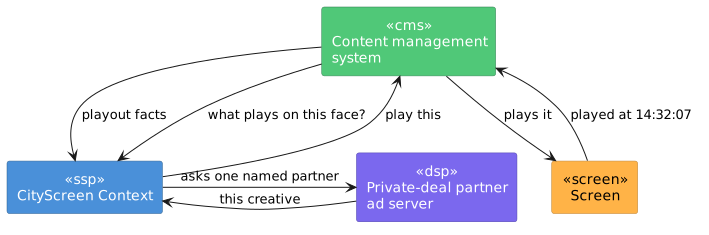
Four things follow from that shape, and they are the whole commercial character of the arrangement.
- The partner chooses
-
Selection happens inside the partner’s own ad server, against whatever campaign, targeting and pacing rules the partner holds there. Bid floors, priority groups and price-list targeting belong to the auction path.
- The partner sets the price
-
The media price is agreed between the operator and the partner outside CS Context.
- CS Context records delivery
-
Every private-deal ad play that the content management system reports back is written to the platform’s private-deal records, timestamped, attributed to a face, a campaign and a partner. That record is the operator’s evidence of what ran.
- CS Context applies its commission
-
The one money figure the platform computes for a private deal is its own commission, through the same fee hierarchy that serves every other deal type. See Fees and commission.
The money that changes hands for the media itself settles outside the platform. Nothing about it appears in CS Context’s financial transactions. That boundary is stated in full in Reporting, and set beside the other accounting models in What gets billed.
Related industry terms
The glossary entry for private deal gives the short definition; this section places it next to neighboring terms.
The industry’s preferred deal is a one-to-one arrangement offering premium inventory at a pre-negotiated fixed CPM, with first-look access before the inventory goes to open auction. A private deal shares the reserved, one-to-one, non-auction character. The price is agreed between operator and partner outside CS Context, and a private-deal opportunity goes to the one named partner.
The industry’s private marketplace is a curated set of premium inventory made available to a select group of buyers at negotiated pricing. A private-deal opportunity goes to exactly one named partner, and the operator assembles no package of faces for buyers to bid into.
The sibling product CS Deals uses deal for a sales contract — a customer, a value, and a pipeline that moves through inquiry, negotiation, booked and paid. A CS Deals deal is a commercial record a salesperson works; a CS Context private deal is a fulfillment path a screen exercises thousands of times a day. The two products share the word and no data.
| If your organization uses both products, use the qualified names in writing and in conversation, because "the deal" can mean either system. |
Which partners this path serves
Three demand-partner types carry private deals in CS Context: HiveStack, Vistar and VIOOH, all established programmatic DOOH demand platforms that CS Context calls out to. Each is a single registered partner shared platform-wide, which each organization then enables for itself, with its own connection details.
Supported partners classifies every partner CS Context integrates with — by what kind of system it is and which direction it talks — and is the one place that table is maintained. Read it before assuming a partner named elsewhere in this documentation participates in private deals; most do not.
Where HiveStack and Vistar behave differently — how each identifies a face, how long each allows for delivery to be confirmed, and what each reports back — the difference is set out in Delivery. VIOOH identifies a face by the VIOOH asset ID recorded on it and allows one hour from the decision for delivery to be confirmed.
What has to be in place
A private deal is a configuration state that makes the path available, and traffic that then flows down it.
-
The partner is registered on the platform and enabled for the organization. Registering is the platform operator’s work and enabling is the organization’s own; see Managing demand partners.
-
The partner’s own connection settings are filled in for the organization — the web address and the credential it issued you.
-
Each face the partner will sell carries whatever identifier that partner expects for it. For HiveStack this is the screen ID recorded on the face, for Vistar it is the face’s GID, and for VIOOH it is the VIOOH asset ID recorded on the face. See Delivery.
-
The organization’s content management system is wired to ask CS Context for private-deal decisions, using the organization’s access token. See Connect your CMS.
-
The platform’s commission for private deals is configured, at whichever level of the fee hierarchy you intend it to resolve. If no level resolves, the commission is zero and delivery is recorded regardless.
Creatives arrive from the partner without the usual submission for review: when the partner returns a creative CS Context has not seen before, the platform imports it as a confirmed campaign and shows it from the next opportunity onward. Delivery describes what that means for the opportunity that triggered the import.
Where this sits among the other sales models
| Sales model | Who decides what plays | Where the money is recorded |
|---|---|---|
CS Context, by comparing bids from every partner in the price list |
A financial transaction per confirmed ad play |
|
CS Context, through the auction path, drawing down a reservation |
Booked as a lump sum when the campaign is activated |
|
Booked ahead and pushed into the content management system |
A price for the campaign as a whole, in the campaign’s own data |
|
Private deal |
The partner’s own ad server |
Settled outside the platform; the platform records its commission |
Sales models carries the full comparison.